
Steps to Parnassus
The crunchy and squishy path to mastery

I’m back in the grip of another music theory obsession. This time I’m learning counterpoint, the study of how to write melodies that sound good together.
I started writing a few paragraphs about why I’m enjoying this so much, and it mysteriously turned into this whole big post that detours through Latin composition and then gets to my thoughts on what was missing from my arts education, and what’s maybe missing from modern arts education in general. I wasn’t expecting that!
Anyway, I’ll get there in stages. Let’s start with counterpoint.
Crunchy and squishy
So, counterpoint is a really standard music theory topic that I should have learned ages ago, but I’d been put off by a couple of misconceptions. First, I thought counterpoint was specifically about how to write the kind of overlapping melodies you’d find in a Bach fugue. I don’t particularly care about fugue, so I didn’t feel much urgency to learn it. But actually it applies to pretty much any situation in classical music where you have two or more voices or instruments.
Second, I thought it would be boring. I knew there was this ancient book written by a guy called Johann Joseph Fux with a massive wig, and you work through it by doing these kind of artificial exercises called things like “second species counterpoint” and “florid counterpoint”.

But then I was feeling a bit stuck with my partimento practice (partimenti are exercises where you compose or improvise music above a given bass line – see my previous musical obsession). Literally stuck: I knew what chords to play on top of a given note in the bass but had trouble knowing how to move to the next note. I could only think vertically, not horizontally. I bought The Art of Partimento by Sanguinetti, and learned that partimento students would learn counterpoint alongside partimenti. It immediately made sense to me that counterpoint is the missing piece.
So I started learning counterpoint out of Fux. And it turns out that I really enjoy it. It’s fun to learn something that’s been taught basically the same way for the last 300 years. Not exactly the same way, because they didn’t have YouTube then, but the videos I’m watching (this series by Jacob Gran) follow a similar teaching method to Fux’s Gradus ad Parnassum from 1725, and I’ve also been referring back to an English translation. Fux turns out to be more entertaining than I expected, in a grumpy old man sort of way.1
There are lots of exercises to work through, and it’s funny how strongly my brain has latched on to thinking about them. I’ve noticed before that there’s a particular shape of problem that it seems to really go for, and counterpoint exercises are a perfect example of it. There should be many possible solutions, not just one, and finding a good solution should involve a mix of making sure you satisfy crunchy hard rules, while also taking into account squishier taste-based guidelines. Kind of like a fruit and nut chocolate bar.
More precisely, the problem should have the following characteristics:
There should be some hard rules that strongly constrain the solution. For example, in counterpoint exercises there are rules about which intervals you have between melodic lines. These are not up for negotiation; you have to produce a solution that satisfies them.
There should also be softer guidelines that indicate what a good solution looks like. In counterpoint, these are things like having a good “shape” to the second line that varies interestingly from the shape of the first line that you’ve been given. For example, it might climb to a high note and back down while the first line descends and reascends, but with the peak and trough offset so they aren’t just boringly mirroring each other. You don’t have to do that, but you probably want to.
This one’s a bit trickier to articulate, but the guidelines should feel open-ended and not like a finished system that you learn once and are done with. Some guidelines like the “shape” one above are basically always important, but other considerations might only activate in the course of thinking about solving a particular exercise. In the first video I watched, Gran is critiquing a possible solution and suddenly brings in the “outside” information that a certain interval tends to sound weak and is not ideal to use.2 This wasn’t something that had been mentioned so far, but it’s relevant knowledge about how harmony works in this style, so it should be incorporated into our sense of a good solution.
Fux structures his book in the form of a dialogue between teacher and student, which works well for this sort of multi-layered problem. The teacher first feeds the student the most basic hard rules, the student has a go at solving the problem, and then the teacher corrects it and introduces more subtle rules.
Joseph.- I shall try. But I hope you will be patient if I make mistakes; I still have very little knowledge in this matter.
Aloys.- Do as well as you can; I shall not mind. The corrections will clarify whatever may be obscure to you.
There can be multiple good solutions with different tradeoffs. Here’s a screenshot from Jacob Gran’s 2:1 counterpoint video showing one of Fux’s solutions, along with two later variants.
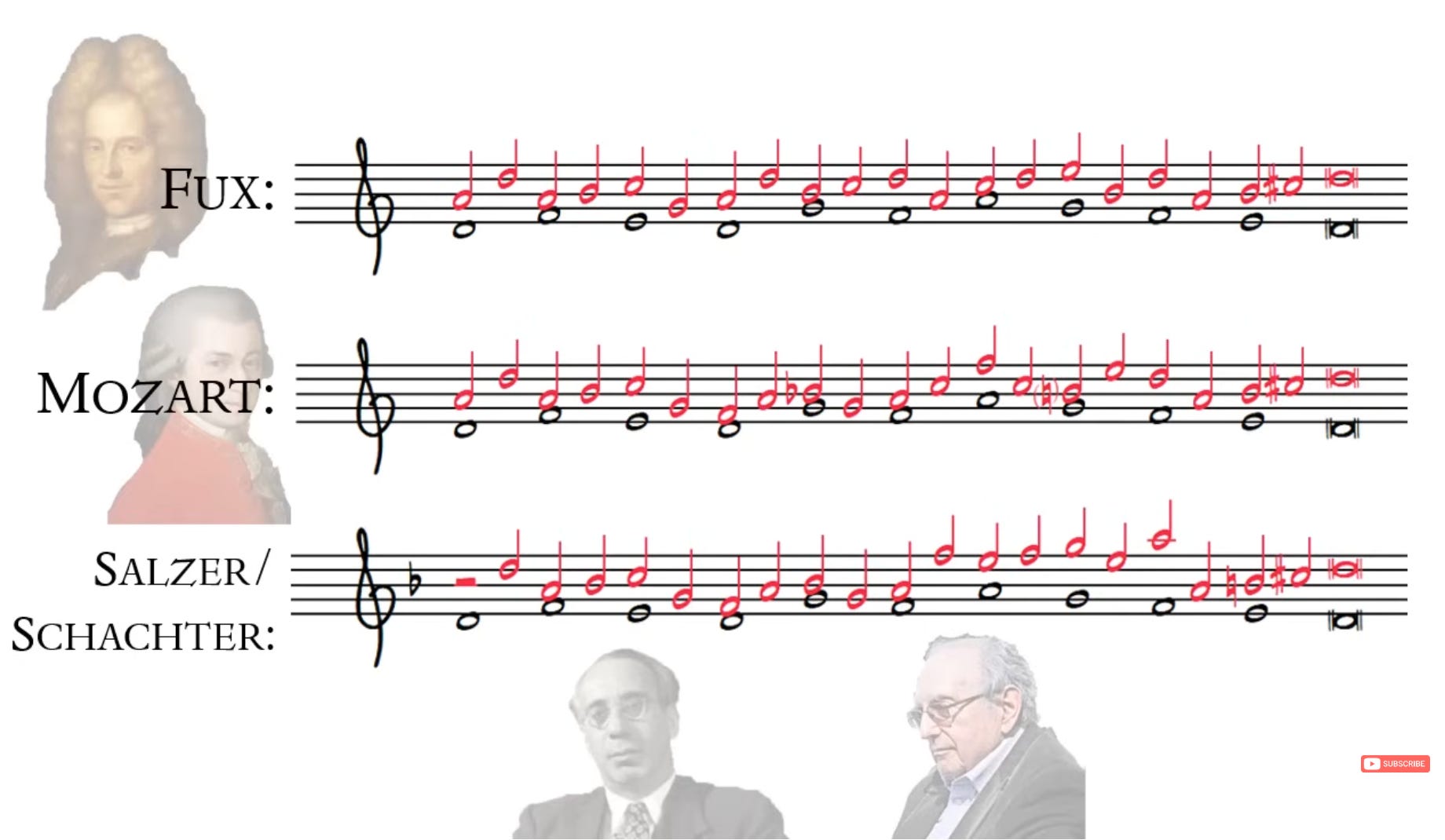
These all satisfy the hard rules (Mozart bends one but doesn’t break it) but make different, valid choices at the taste level. This kind of education is about slowly training your sense of taste within the constraints of a simplified exercise structure.
Bees
A couple of years ago I read Tom Brown’s School Days, and for some reason one part that really stuck in my head is a mundane scene where the boys are doing their Latin composition homework. I had the sense that the kind of work they were doing had a similar shape to the counterpoint exercises, and when I looked it up for this post it was an even better fit than I imagined. The textbook they used was also called Gradus ad Parnassum!3 So maybe I was actually on to something.
I’m fairly sure the book in Tom Brown was this one4 by John Carey, a 19th century revision of a 1686 book by Paul Aler. It’s a kind of poetic dictionary, a collection of stock phrases you can use to fill out your Latin composition homework.
I don’t know Latin, but as far as I can see the book works in the following way. Let’s say you need to grind out a few lines about bees. You go to the entry for “apis”:
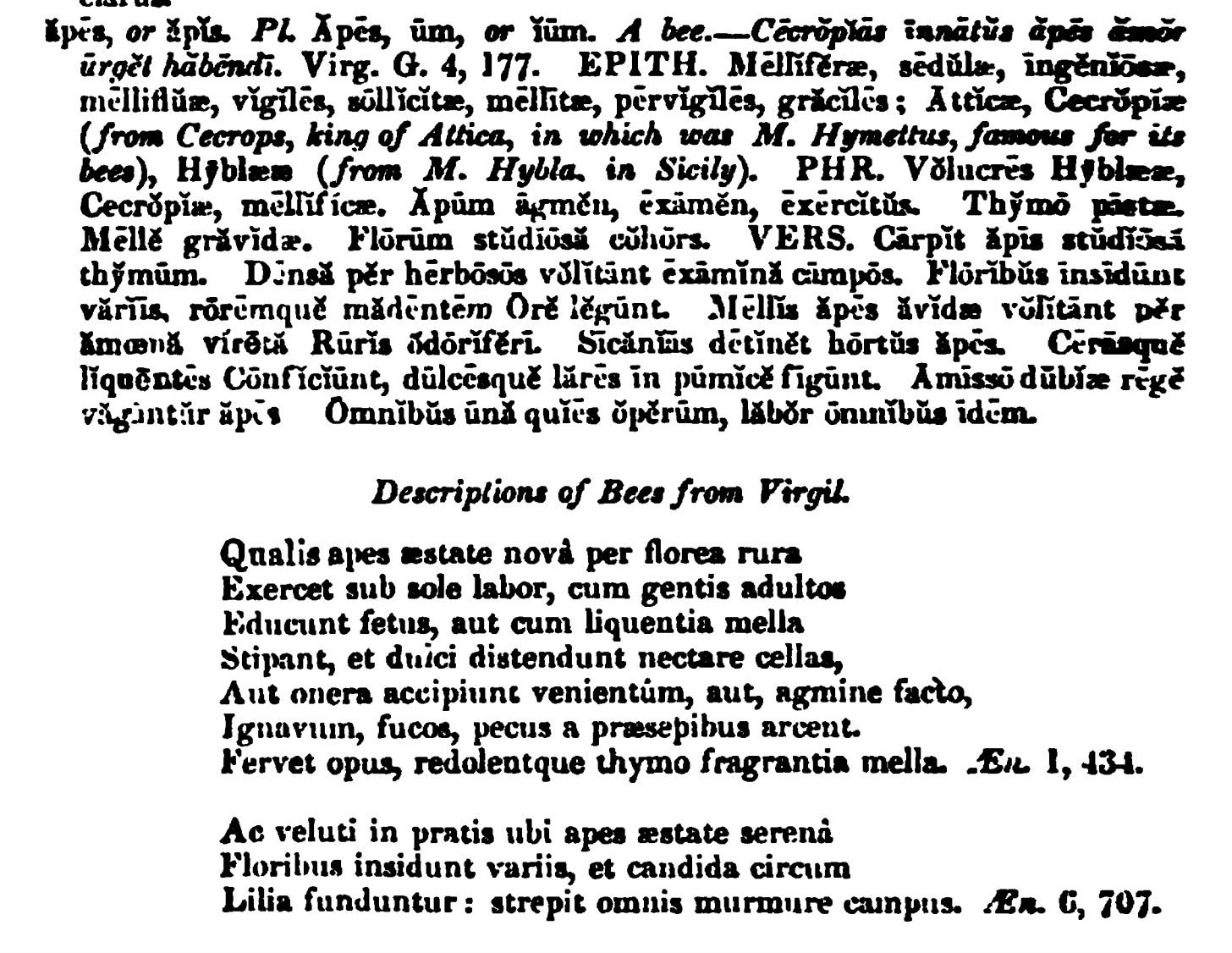
The entry gives you a bunch of relevant lumps of bee-themed text. For example, there’s a list of standard epithets you could attach to them: melliferæ (honey-bearing), sedulæ (diligent), ingeniosæ (watchful). Then there are phrases and verses that you could borrow or adapt, and finally some longer example excerpts from Virgil.5 It also shows the patterns of stressed and unstressed syllables (the symbols above the words), which is important if you’re writing poetry.
The boys in Tom Brown’s School Days use this as their main reference book. One of their standard homework tasks is something called the “vulgus”, a short Latin composition on a given theme. Tom outright cheats his way through his vulgus with the help of an interesting social technology called the vulgus-book, which I’ve written about before. So he gets away with not using the Gradus much.
Tom’s friend Martin does need it, though. Martin is a nerd who is obsessed with science and natural history, and doesn’t care at all about the classical syllabus that the school teaches.6 He’s not popular enough to have a vulgus-book, so he cranks through the exercise by reducing it to hard rules:
Martin then proceeded to write down eight lines in English, of the most matter-of-fact kind, the first that came into his head; and to convert these, line by line, by main force of Gradus and dictionary into Latin that would scan. This was all he cared for—to produce eight lines with no false quantities or concords: whether the words were apt, or what the sense was, mattered nothing; and as the article was all new, not a line beyond the minimum did the followers of the dogged method ever produce.
Tom’s other friend Arthur is actually talented at Latin composition. He gets all the hard rules right, but he’s aiming much higher than that. He wants to find the best result he can that fits the both the hard grammatical rules and the long tail of squishier constraints:
He considered first what point in the character or event which was the subject could most neatly be brought out within the limits of a vulgus, trying always to get his idea into the eight lines, but not binding himself to ten or even twelve lines if he couldn’t do this. He then set to work as much as possible without Gradus or other help, to clothe his idea in appropriate Latin or Greek, and would not be satisfied till he had polished it well up with the aptest and most poetic words and phrases he could get at.
This is a similar style of training to learning counterpoint. It’s interesting that both books use this same analogy of Gradus ad Parnassum (“a step towards Parnassus”). In Greek mythology, one peak of Mount Parnassus was sacred to Apollo and the nine Muses, and the other to Dionysus. So the idea is that you climb towards the mountain on a gradual (step-by-step) path to mastery.
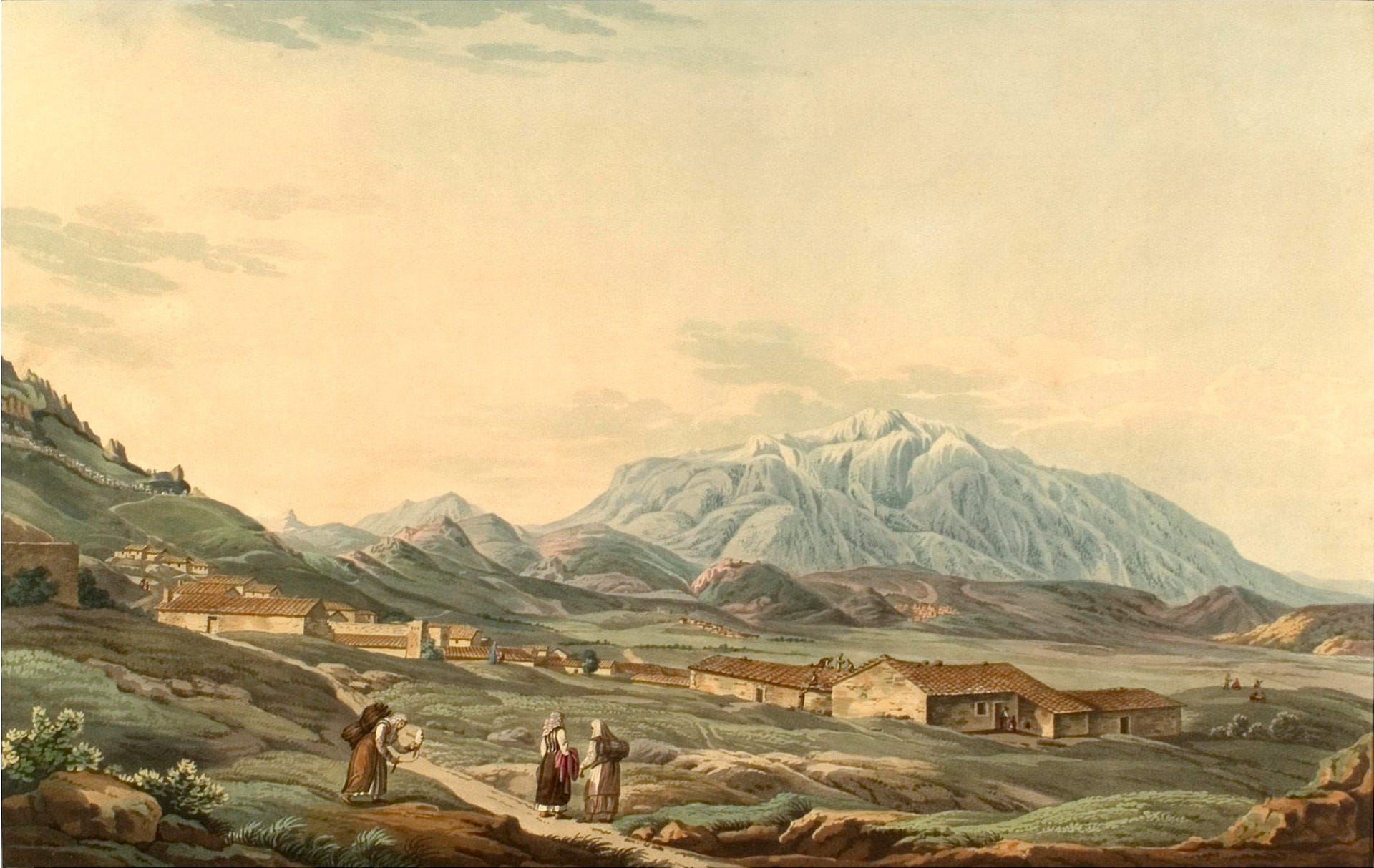

I couldn’t really figure out the history of how this title got started, but Fux and Aler both come out of the Jesuit educational tradition, so maybe there is something there. In any case, it became a standard name both in Latin composition (there were many translations and rewrites of Alers’ book) and in music (where it was applied to lots of other pedagogical works).
Method-wise, there is something similar about the two books, though they are sort of inverted. Fux gives you a set of exercises, and you bring your general musical knowledge to them. With Aler and derivatives, the teacher provides separate exercises (something like Tom Brown’s vulgus), and the book provides useful background information for filling them out. Either way, you need a series of increasingly difficult exercises, and also a way to gradually develop your taste for what a good solution looks like.
Missing steps to Parnassus
I’m struck by how little my education emphasised this kind of work. The vast majority of it was at the far ends of the crunch-to-squish spectrum, with very little in between.
In secondary school I had plenty of maths classes where we solved increasingly difficult problems. I was good at that and liked it, so I went on to do a maths degree as well. I got a strong education in how to solve systems of hard rules and find the single correct solution. My science education was also pretty decent. I learned facts, equations, experimental procedures, that sort of thing. Crunch heavy.
Outside of STEM, we went way to the squish end of the spectrum. I guess we did learn some facts in history and geography, normally about some isolated “topic” like “the Tudors” or “the Amazon rainforest”. Rote learning was out of fashion so fact accumulation was done haphazardly. There wasn’t much interest in connecting islands of facts together.
The default kind of work we did, though, was some chunk of open-ended writing. In English or history class we spent a lot of time on writing essays and short responses on questions like “what are the motivations of this character?” or “how reliable is this source?” Reasonable questions to think about sometimes, but not ones where the output is particularly constrained.
Art and music classes were almost structureless. We’d attempt to paint some still life or pick out a simple tune on the keyboard, but there was barely any instruction in any kind of systematic technique that would help you improve at these things. At the most you could learn that you enjoyed mixing paints or banging a drum, which is not nothing, but any guidance on how to get better at them would have to come from somewhere else.
I think the late 90s / early 00s were probably a local minimum in the UK for caring about teaching systematic rules. Nobody even taught me any English grammar beyond what a noun and verb were. Just after I left primary school, the government introduced something called “the literacy hour”, which sounds pretty dire but did at least attempt to teach grammar. I talked to a primary teacher once and she told me a couple of grammar terms that she was currently teaching her kids that I’d never even heard of as an adult.7 So maybe things have changed somewhat. Still, I don’t think we’ve got usefully closer to having a path up Parnassus. As far as I know there’s no systematic attempt to combine rules and taste in a domain.
I understand why this no longer exists, in broad strokes. Postmodernity weakened the canon of elite education, so kids are no longer grinding through Latin and Greek as the main focus of their studies, and there’s no default activity to replace it (how would you choose one?). We also don’t especially value the kind of trade-specific education we once gave to musicians, who were not themselves part of the elite, just employed by them. So the apprenticeship path is mostly blocked too.
It’s hard to defend bringing back any one subject for literally everyone. Musical education was always niche, and a classics education only ever served some students well. What I’m sad about is more the complete lack of exposure I had to this type of thinking, so that I never even had the chance to develop it.
Partly this is because I love the texture of counterpoint exercises and would have been very happy to fill my brain up with them, or something similar (I get the sense that I’d have enjoyed Latin composition too). As an adult I found my way to technical writing, which is a kind of strongly constrained writing that sometimes scratches the same itch, but it took a long time to get there.
But also it seems important at a societal level to have a path to learning rigour in the arts and humanities as well as the sciences. David Chapman has been writing a lot more about this, most recently in Ofermōd:
… metrical analysis is part of understanding how and why a poem works. It’s a gritty, geeky, rational, systematic part—and therefore disdained by refined souls in postmodernity. It was a critical piece of elite education in modernity. That’s not because rulership relied on metrical analysis. It is because rulership relied on systematic rationality, and metrical analysis is one way to learn what that means—just as much as learning Newtonian mechanics can be.
Meter forms the base layer of analysis. It is the most rigid one; a nearly pure level of pattern. In subsequent, higher levels you encounter the interplay of pattern and nebulosity.
The “steps to Parnassus” style of education teaches systematic rules while naturally leading you to the higher levels of mixing pattern and nebulosity.
I’m emphasising the “arts students learning rigour” side here, rather than the “nerds learning taste” side. I also do think it would be a very good thing for nerds to learn taste! But I’m fairly convinced by the sort of Kegan-style developmental stage theory David Chapman talks about. There’s too much to cover in a short comment here, but roughly speaking, in this model learning to think systematically for the first time is the distinctive task of teenagers and young adults. So the deficit of crunch on the arts side seems worse to me than the deficit of squish on the science side, because it blocks the main developmental path.
I don’t have a big satisfying conclusion on what we should do about any of this. This was only meant to be a short post about counterpoint, so I’m surprised I even got this far. Still, I've found the partimento revival I’ve been writing about inspiring as a model for how serious learning could work, even if 18th century Neapolitan improvisation techniques are a bit too niche to teach at scale. There’s an interesting mixed culture of musicologists in academia digging back into the history, and independent YouTubers figuring out teaching methods that work well and popularising them, and the two seem to feed into each other in a useful way.
At a more personal level, I’m enjoying bumbling my way around the Parnassus foothills, and I expect I’ll keep posting about what I find here.
It’s been some time since I last wrote anything here. That’s because I moved to London to work for Antithesis, and completely trashed my routines for writing outside of work for about six months. I’m getting the hang of things again now and will hopefully be posting more, but it could still be patchy for a while.
Fux starts the book with a complaint about music these days: “Some people will perhaps wonder why I have undertaken to write about music, there being so many works by outstanding men who have treated the subject most thoroughly and learnedly; and more especially, why I should be doing so just at this time when music has become almost arbitrary and composers refuse to be bound by any rules and principles, detesting the very name of school and law like death itself.“
This feels like too much of a coincidence! I think the phrase must have been buried somewhere in the back of my mind, and so seeing it again triggered the memory of Tom Brown. I didn’t consciously remember, though, so I was very surprised.
Annoyingly that archive link only has part of the text for some reason. You can read about bees though.
There are several more of these excerpts that I cut off the screenshot. The entry for bees is unusually long, because Virgil was really into them apparently.
I think Hughes mainly put Martin into the book as an opportunity for a rant about how poorly English public school education treated boys who were talented at science but uninterested in classics.
I still haven’t learned English grammar. Despite being a technical writer. Oops.
Intriguing!
Thinking about whether I had crunchy-with-squishy things I learnt as a child - I liked school, and like you the science/maths stuff was plenty crunchy. I enjoyed subjects like English and History, but as far as I remember they didn't give much guidance it was mostly (to quote a video games meme) "git gud". Hmm, actually perhaps there was a bunch of grammar stuff earlier on?
The most obvious thing I did that combined them was programming. This was in the 1980s. The language itself, and making the thing work was crunchy. But then what to make with it, how fun it is, is squishy. The exercises to teach were things like Osborne Books, which were maybe more similar to what you're talking about than I at first thought - lots of copying programs into the computer, but naturally you'd get hard rules wrong and have to debug them, and want to alter soft creative decisions in them but still keep it working.
I found my limited early music education not squishy enough - grade 2 piano as far as I can remember was just learning how to reproduce things, and involved no creation with or without rules. I think that's definitely a reason I found the computer more interesting.